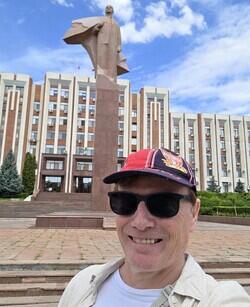
Lenin monument, Tiraspol, Transnistria.
Photo. Lenin watching my back outside the Parliament Building in the capital Tiraspol.
What if the Soviet Union never ended? Transnistria must be the place where history refuses to move on.
My journey in Transnistria began under the watchful eyes of stern border guards, a stark reminder that, despite its lack of widespread international recognition, this breakaway territory functions entirely on its own terms. Once through the checkpoints, the landscape changed dramatically.
Transnistria felt strangely unreal. The border crossing itself was enough to spark my curiosity. Uniformed guards checked documents with serious expressions, reminding me that this was no ordinary destination. Although officially part of Moldova, Transnistria operates as its own state, complete with its own government, currency, and identity.
Travel advises:
Please, be aware of the risk going to Transnistria at the moment (I was there on 9th July 2026).
Areas where FCDO - Foreign, Commonwealth & Development Office (FCDO) warn about, based on information from the website GOV.UK: FCDO advises against all travel to Transnistria. There is widespread military activity in Ukraine, including close to some Moldovan borders. Transnistria is outside the control of the Moldovan government.
According to Travel.State.Gov (U.SA Department of State): Reconsider Travel to Transnistria due to risk of armed conflict. There are ongoing security threats related to Russia’s war against Ukraine.
My destination was Tiraspol, the capital of this unrecognised breakaway region inside Moldova. Walking through its wide, spotless boulevards felt like wandering through a living museum. Soviet-era apartment blocks stood proudly along the streets, while statues of Lenin watched over public squares. Hammer-and-sickle symbols, long removed from most of Europe, still remained part of everyday life here.
As shown on the photo, Lenin is watching my back outside the Parliament Building (Supreme Council) in the capital Tiraspol. Actually this is a massive red granite statue of Lenin with his cape billowing behind him, looking like a Sovjet superhero keeping an eye not only of me, but the whole capital.
Next to the Lenin statues and other towering Soviet monuments, I observed modern supermarkets, the pulsating Tiraspol Green Market, the impressing Sheriff Stadium, restaurants, cafes, playgrounds, beautiful parks with ponds, and locals chatting and scrolling on smartphones. It`s a bizarre fascinating contrast of 1985 meeting 2026.
It seems to me that Soviet past and the modern world existed side by side on the same street. Few places make the passage of time feel so tangible, where history is not confined to museums but remains woven into the everyday landscape.
At first glance, Tiraspol seemed frozen in time, like a monument to a vanished empire. Yet the more I explored, the more I realised that the city was far more than its history. Beneath the concrete facades and political uncertainty, life moved on. People laughed in cafés, children played in parks, pulsating huge markets, and friends and families gathered in the evening sunlight. The true spirit of Transnistria was not found in its monuments, but in the people who continued building their lives in this unusual corner of the world.
While the rest of Europe move on, the capital Tiraspol leans hard into its mid-century aesthetic. The connection to Russia was visible everywhere in Transnistria. Russian was the main language I heard in the streets, Russian flags appeared beside Transnistrian symbols, and memories of the Soviet Union still shaped the region’s identity. Many residents have Russian passports, while others hold Moldovan or Ukrainian citizenship, sometimes more than one at the same time. Russia has also supported Transnistria economically and politically, and Russian troops remain stationed in the territory.
Yet I understood that the people could not be placed into one simple group. Some feel culturally close to Russia, some depend on it for pensions, energy, or security, while others look toward Moldova, Ukraine, or Europe. For many, the relationship may be less about ideology and more about family ties, language, daily survival, and a history inherited from the Soviet period.
As I walked through Tiraspol, I felt that Russia was present not only through flags, statues, and soldiers, but also through habits, memories, and the way people understood their place in the world. Transnistria seemed caught between several identities: legally part of Moldova, closely connected to Russia, and geographically pressed against Ukraine. That tension made the region feel like more than a frozen political conflict. It felt like a place where ordinary people were still trying to build normal lives between powerful forces they could not fully control.
Before continuing my journey, I stopped for lunch in a small Bulgarian village surrounded by open countryside. Here the time seemed to move as slowly as the clouds drifting above the fields. It was really relaxing. The food was excellent, the service warm, and the local red wine was outstanding. As I walked around in the beautiful green garden, I looked across the fields, watching village life unfold at its own unhurried pace.
The highlight of my journey was on my last stop, the Bendery Fortress. Standing on its massive stone walls and looking across the winding Dniester River, I imagined the centuries of conflict that had unfolded here. Ottoman armies, Russian forces, and countless others had passed through these lands, each leaving behind traces of their story. The fortress felt like a bridge between past and present, reminding me how history never truly disappears.
As I crossed back over the river, leaving this geopolitical time capsule behind, I carried a deeper reflection with me. Borders, governments, and empires may come and go, but human resilience remains. In places like Transnistria, I am reminded that the greatest discoveries are not always found in famous landmarks. Sometimes they are found in the unexpected places that challenge our assumptions and reveal how people continue to hope, adapt, and thrive against all odds.
For me, adventure is not always found on remote mountain peaks or in extreme landscapes. Sometimes it is found in places that challenge my understanding of the world and remind me that history is never truly gone. It lives on through the people who carry it forward. And perhaps that is what exploration is really about: stepping beyond the familiar and discovering new ways of seeing both the world and ourselves.
Stein Morten Lund, 14th July 2026
Additional information
In April this year (2026) I entered the border to another self-declared state, the Turkish Republic of Northern Cyprus (TRNC). It`s a territory that declared independence in 1983 but remains internationally unrecognized except by Turkey.
Here is my story:
Varosha, Cyprus – The Silence That Still Speaks. Entering Varosha felt different from any place I had visited before. The military presence was impossible to ignore. Checkpoints, watchtowers, and warning signs were constant reminders that this was not an ordinary destination. Permission was required to enter, and soldiers carefully monitored the area. Even taking photographs demanded caution. Every step carried a sense that unseen eyes were watching.
As I walked through the empty streets, an uneasy silence settled around me. It was not the peaceful silence of nature or an abandoned village slowly reclaimed by time. This silence felt heavier. It seemed to hold memories.
Before 1974, Varosha was one of the Mediterranean's most glamorous seaside resorts, attracting celebrities, tourists, and wealthy visitors from around the world. Then, during the events that followed the Turkish invasion of Cyprus, everything changed. Residents fled their homes, often believing they would return within days. Many never did…….
Read more on our global travel guide Travel Explorations.







 E-mail this
 Print this