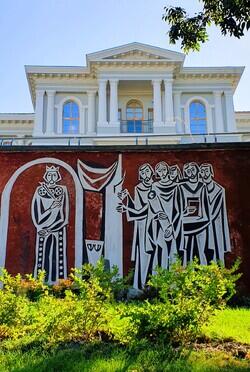
Monumental art on the Three Hills, Old Plovdiv in Bulgaria
Photo. Wallpainting by Georgi Bozhilov in Plovdiv, Bulgaria. © Travel Explorations.
At the hilltop Nebet Tepe, I sat above Plovdiv with a quiet drink, watching the city fold into itself like a living map. The stones beneath me carried the weight of Thracian fortresses, Macedonian ambition, Byzantine, Ottoman, and Roman order. Here are centuries layered across a summit shaped by time itself. Archaeologists still carefully excavate this ground, as if the past isn’t finished speaking.
I wandered down through the Old Town, past Revival houses with wooden balconies and sun-faded facades, churches and chapels. There’s something quietly captivating about Plovdiv. It feels ancient, but never distant. And that is for sure: Plovdiv is actually one of the oldest continuously inhabited cities in Europe.
On my way the Ancient Theatre of Philippopolis opened before me like a memory still in use. Further down, near the pulse of the modern city, the walls began to speak. Monumental art emerged, not framed or protected, but alive in the everyday.
I paused longest at the work of Georgi Bozhilov. His sgraffito, depicting Cyril and Methodius, tells the story of alphabet and identity, and how language itself can shape a nation. Nearby, his mosaic in the Central Post Office felt like a continuation of that same quiet force.
I liked that these fascinating arts were not hidden in museums, but placed where people walk, eat, laugh, and pass by. It asked me to look longer. And that struck me more than any summit view.
It became a living history lesson for me. I understood that adventure isn’t only about the climb to the top, but about moving slowly, paying attention, and seeing that courage can lie in preserving meaning, so the world shows itself not just in the present, but through everything that shaped it.
Stein Morten Lund, May 2026
Additional information
Plovdiv is often described as one of the oldest continuously inhabited cities in Europe. Archaeological evidence shows settlement on the Three Hills dating back more than 6,000 years, to Neolithic times. Over the centuries, it evolved through Thracian, Macedonian, Roman, Byzantine, and Ottoman periods, each leaving visible layers in today’s city.







 E-mail this
 Print this