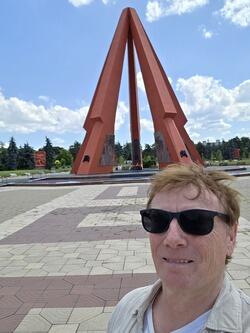
Eternity Memorial Complex in Chișinău, Moldova
Photo. Me standing in the front of the pyramid monument inside the Eternity Memorial Complex in Chișinău, Moldova. A powerful history lesson for life.
© Travel Explorations.
The contrast between bustling modern Chișinău and the peaceful atmosphere inside the memorial. It`s a place where silence keeps history strong alive. This goes far beyond the history books. These monuments truly speak, making me feel what history was really like.
There is a fascinating paradox along P. Halippa Street. Beyond the memorial grounds, Chișinău moves to the rhythm of modern life: cars rush by, people hurry between appointments, and the city continues its journey into the future. Yet the moment I stepped inside the complex, the noise seemed to fade away. Silence replaced movement, and reflection replaced distraction.
As I entered the park, I took my time to stand in the front of the towering crimson pyramid of the Eternity Memorial Complex for a while. It`s one of Chișinău's most striking landmarks. At its center, the eternal flame burned steadily beneath five giant stone rifles reaching toward the sky, a powerful reminder that the soldiers who fought and died here would not be forgotten.
The towering stone rifles rising into the sky, the eternal flame burning quietly at their center, and the changing honor guard created an atmosphere of reflection and respect.
As I walked through the park, I found myself slowing down, observing the details, the silence between visitors, and the way people interacted with the memorial. The history suddenly felt closer, more human.
It gave me a far deeper connection to history than simply reading about it. Known during Soviet times as the Victory Memorial, the monument is dominated by five towering stone rifles, each 25 meters high, forming a striking pyramid around an eternal flame burning within a five-pointed star (based on information from travelomoldova.com).
As I wandered along the quiet alleys, I noticed the 155 marble slabs engraved with the names of soldiers who lost their lives in the battles to liberate Moldova and Chișinău during World War II. The six stone stelae mark key milestones of the war, from its earliest days to the final victory. Surrounded by white stone and silence, the memorial felt less like a monument and more like a place where memories still live.
The complex was reopened after restoration on 24th August 2006, commemorating the liberation of Moldova from German-Romanian forces in 1944.
These monuments seemed to come alive, allowing me to feel history rather than simply read about it. What struck me most was how places like this connect past and present. Thousands of soldiers once fought and died here, while today people walk peacefully through the grounds, often unaware of the sacrifices that shaped the world around them. Seeing the monuments in person gave me a stronger understanding than any historical article could.
Travel often teaches me that the real value of history is not found in dates or statistics, but in experiencing the places where events unfolded. Observing these monuments reminded me that curiosity is more powerful when it leads us beyond books and into the world itself. Sometimes, understanding the past begins with simply being present and seeing a place with our own eyes.
Stein Morten Lund, 15th July 2026







 E-mail this
 Print this