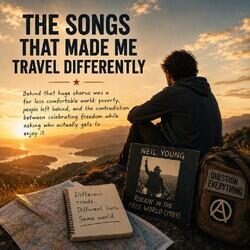
The songs that made me travel differently. For me, it began with Neil Young's Rockin' in the Free World in 1989, two years after I travelled around the world.
Photo. A lesson for life following a different kind of map for seeing the real world. Generated by DALL·E 2 - Chat GTP4 from OpenAI.
I wasn't prepared for what I saw during my first long journey. The poverty, homelessness, addiction and inequality were unlike anything I had experienced before, and they changed the way I saw the world. Neil Young's Rockin' in the Free World (1989) gave words to much of what I had witnessed.
Then I really understood, Neil Young's "Rockin' in the Free World" (1989) was not a patriotic anthem because of its huge, anthemic chorus. In reality, it's a deeply ironic protest song about the gap between the American ideal of freedom and the lives of many ordinary people. It was the song that truly opened my eyes and made me think more deeply about inequality, freedom and the people society leaves behind.
When I first heard Neil Young's Rockin' in the Free World in 1989, I loved it for all the wrong reasons. Like many people, I was swept along by its driving rhythm and enormous chorus. It sounded triumphant, almost celebratory. Only much later did I stop and list en to what Young was actually singing. The song wasn't celebrating freedom at all. It was exposing the uncomfortable gap between the ideal and the reality. Beneath that unforgettable chorus lay stories of poverty, homelessness, broken promises and people left behind. By then I had already travelled around the world. Those lyrics suddenly made sense in a way they never could have before. I realised that I hadn't simply misunderstood a song. I had misunderstood the world.
By then, I had already travelled around the world and seen things I wasn’t prepared for: homelessness, addiction, poverty and inequalities far removed from the places shown on postcards. Suddenly, Young’s song sounded different. Beneath its energy was an uncomfortable question about freedom: who actually gets to experience it? That question began travelling with me.
The more I travelled, the more my attention shifted from simply seeing places to understanding the people who lived there. I became curious about their everyday lives, their struggles and hopes, and how differently people experienced the world depending on where they were born.
What protest music taught me about travelling
Music became a second map of the world for me, teaching me to look beyond landscapes and postcards toward inequality, colonial history, Indigenous experience, power and the people whose stories are often overlooked.
During my years of travelling around the world, I saw many of the same realities that Neil Young was singing about. Poverty, people sleeping rough, drug addiction and people struggling simply to get by weren't distant issues any more; they were part of the places I was visiting. It made the song feel less like a political statement and more like an observation about the world. Travelling didn't give me all the answers, but it made the questions in those lyrics much harder to ignore.
I have visited dark places in the USA, South African townships, Brazilian favelas and other communities where poverty, inequality, homelessness and addiction were part of everyday life. Neil Young's lyrics no longer felt like a commentary on someone else's world; they echoed what I was seeing with my own eyes.
I began searching for music that challenged me in the same way. Political music became an unexpected guide to the places, people and histories I encountered along the way. The Clash led me towards questions of war, racism and unemployment. The Jam wrote about British society, class and the political tensions of their time. Chumbawamba introduced me to anarchist ideas, challenging capitalism, consumerism, nationalism and social inequality while fighting for workers' rights and against fascism, and embracing direct action.
Other songs became part of that journey. The Tom Robinson Band, Dead Kennedys, Manic Street Preachers, and Billy Bragg showed me that politics could be deeply personal rather than simply ideological. Their songs encourage listeners to question power, history and the stories societies tell themselves, rather than simply expressing anger or protest. I began to realise that music could be a different kind of travel guide.
One of my biggest favourite songs is "Beds Are Burning" by Midnight Oil. As I see it, it`s one of the most important political rock songs ever written, and that is because it connects music so well with travel, history and Indigenous perspectives. In some of the places I visited, I was saddened by how poorly Indigenous people were still being treated.
Midnight Oil took me somewhere else entirely. Beds Are Burning remains one of the most powerful songs ever written about Indigenous rights. Long before I understood Australia's history properly, the song challenged me to ask why some people inherit privilege while others continue living with the consequences of colonisation. Years later, after visiting places where Indigenous communities still faced discrimination and marginalisation, those questions felt even more urgent. Good music has a habit of staying with you long after the final note fades.
Not to forget Dead Kennedys with satirical, sharp critiques of American politics and consumer culture, and Propagandhi with technically brilliant melodic hardcore covering anti-capitalism, animal rights and foreign policy. Their song “Haillie Sellasse, Up Your Ass” is particularly hard-hitting, taking aim at organised religion, war and oppression while questioning beliefs that can be used to justify intolerance and inequality.
The good old band Proletariat fascinated me for a different reason. Emerging from Boston's early-1980s punk scene, they drew heavily on British post-punk bands such as Wire and Gang of Four. Even their name pointed directly towards class, labour and Marxist ideas.
The music that really opened my eyes
As my travels continued, so did my musical journey. Then came heavier sounds. Bad Religion and System of a Down turned political anger into something almost tangible. More recently, bands such as High Vis, Home Front, Body Counts and Dead Pioneers reminded me that this tradition never disappeared. The circumstances changed, but the questions remained.
Then I recently discovered the Irish avant-garde punk artist Meryl Streek, who confronts institutional abuse, power and accountability with an uncompromising blend of spoken word and punk.
So discovered Dead Pioneers, and the perspective shifted again. Their music confronts colonialism, Indigenous experience, inequality and the stories nations tell about themselves. It echoed something I had encountered repeatedly while travelling: history depends enormously on who is telling it.
Many contemporary bands such as High Vis, Home Front, Body Count, Dead Pioneers and Meryl Streek carry forward the socially conscious spirit of earlier punk while incorporating elements of post-punk, hardcore and spoken word.
A monument can celebrate a pioneer. A history book can describe a conquest. A border can seem permanent on a map. But stand in the same place with someone whose ancestors experienced those events from the other side, and the story changes.
With each passing year, the political and social fault lines seem to grow deeper. As the world becomes more divided, a new generation of punk has become louder, faster and even more uncompromising. Looking back, I can link some of my most memorable journeys and adventures to particular songs that changed the way I understood the places I was exploring.
These are the artists and music that changed not only what I listened to, but how I travelled. The older I get, the more it feels as though the world's divisions are becoming harder to ignore. Especially punk has responded in the only way it knows how: louder, faster, more aggressive and with even greater conviction. When I think back to my travels, many places are tied to a particular song, and many songs immediately take me back to a particular place.
Travelling beyond the postcards
That is where music and travel came together for me. From High Vis and Home Front to Dead Pioneers, I kept hearing different versions of the same unsettling question: whose world are we actually looking at?
As I travelled, I began noticing things I might once have walked past: workers leaving before dawn, abandoned factories, strike memorials, Indigenous histories, political graffiti and neighbourhoods reshaped by money and power.
Perhaps political music became a different kind of travel guide. It taught me that adventure is not simply about reaching remote mountains, deserts, ancient wonders or forgotten places. Sometimes the greater adventure is questioning the story you arrived with.
Dead Pioneers marked another turning point. Until then, I had mainly listened to songs about class and political struggle. They pushed me to ask a broader question: who gets to write history in the first place?
The songs that genuinely influenced me.
Some songs that changed the way I see the world:
- Neil Young – Rockin' in the Free World
- The Clash – Clampdown
- Midnight Oil – Beds Are Burning
- Chumbawamba – Enough Is Enough
- Gang of Four – Natural's Not in It
- Propagandhi - Haille Sellasse, Up Your Ass
- I Hate the White Man - Roy Harper
- People Have The Power - Patty Smith
- Bad Religion – American Jesus
- The The – Armageddon Days Are Here (Again)
- Manic Street Preachers – If You Tolerate This Your Children Will Be Next
- Rage Against the Machine – People of the Sun
- Dead Pioneers – Bad Indian
- Meryl Streek – Death to the Landlord
- This is How We Ride - Body Count
- Trauma Bonds - High Vis
- The Vanishing and Nation - Home Front
- ICE Too Cold To Thaw - David J & The Resistance
Together, these songs trace many of the themes I became obsessed by: inequality, consumerism, religion, colonialism, Indigenous history, war, power and the stories societies tell about themselves. They also span four decades, showing that politically engaged music has continued to evolve rather than disappearing.
Once you begin listening to the people who experienced history from the other side, even familiar landscapes start to look different. Perhaps that is what these songs ultimately gave me: a different kind of map. They taught me that adventure is not only about reaching remote mountains, ruins or forgotten roads. It can also mean stepping into someone else's history and trying to understand what made people organise, protest, fight, sing, or simply refuse to accept the world as it was.
When I think back to my travels, many places are tied to a particular song, and many songs immediately take me back to a particular place.
Songs such as This Is Why We Ride by Body Count and Death to the Landlord by Meryl Streek reminded me that political music is still very much alive. Although the issues have changed, the underlying questions remain the same: who holds power, who benefits and who gets left behind? They carry the same spirit that first drew me to bands like The Clash, The Jam and Chumbawamba.
The music that taught me to look closer
Just as Neil Young`s song Rockin`in the Free World, I realise now that a song could sound celebratory while delivering a sharp political critique. That discovery naturally leads into artists such as The Clash, Chumbawamba, The Jam, so further to Bad Religion, System of a Dawn, Home Front, High Vis, Body Count and Dead Pioneers, all of whom also use music to challenge accepted narratives.
The further I travelled, the more I realised the songs were never taking me away from the world. They were teaching me how to see it.
Stein Morten Lund, 12th August 2026
Additional information
After The Clash it became harder, heavier and, in many cases, even more confrontational.
Bruce Springsteen released Streets Of Minneapolis, a protest song denouncing “King Trump and his private army” following the killing of Alex Pretti and Rennee Good by ICE officers in the city.
MOJO Music Magazine has compiled a list of the greatest protest songs, celebrating artists who used music to challenge injustice and give a voice to social and political change. According to MOJO, the greatest protest songs share a common belief: that music can do more than entertain. It can challenge power, inspire debate and even help change society.
The co-founder Roger Waters in former Pink Floyd joined the Palestinian singer Mona Miari in June 2026 to release a protest version of the 1979 Pink Floyd classic "Comfortably Numb". It`s dedicated to the people of Palestine and Gaza. The original refrain "I have become comfortably numb" is turned to "I will never become comfortably numb," making the song into a protest anthem.
Many contemporary bands such as High Vis, Home Front, IDLES and Dead Pioneers carry forward the socially conscious spirit of earlier punk while incorporating elements of post-punk, hardcore and spoken word.
Pink Floyd,







 E-mail this
 Print this