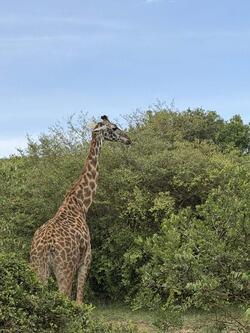
Giraffe in Kenya
Photo. A hungry giraffe eating from the top of the trees in Kenya. © Travel Explorations.
The Giraffe is the world's tallest land animal. Males are reaching an average height of 4.6 to 6 meters (15-20 feet) and females measuring slightly shorter at 4 to 5.2 meters (13-17 feet). A giraffe’s legs alone are about 6 feet tall - taller than the average human (source: Tsavo Trust). Their neck a long length of 2.4 meters.
The Giraffe, the silent giant of Africa, may look untouchable as it glides above the savanna with its long neck and calm eyes. But behind that elegant height lies a daily fight for survival.
Based on information from Giraffe Conservation Foundation, the giraffe population in Africa has declined significantly, with only around 140,000 individuals remaining. While this number is higher than previous estimates, three of the four giraffe species are highly threatened and require urgent conservation efforts.
Giraffe are extinct in 7 African countries. Over the past 35 years, combined giraffe numbers have decreased markedly. In regions once considered prime habitats, their numbers have dropped by up to 95%, and collectively giraffe have lost nearly 90% of their historical range over the last three centuries.
According to African Wildlife Foundation, in Nairobi, Kenya, Giraffe tails are highly prized by many African cultures and are used in good-luck bracelets, fly whisks, and even thread for sewing or stringing beads. The world's tallest land animal has lost 40 percent of its population in just 30 years, and recent reports show poaching and wildlife trafficking are contributing to this decline. Giraffes are easily killed and poaching - now more often for their meat and hide - continues today.
With a neck that looks almost unreal, the giraffe doesn’t just live in Africa - it rises above it. While other animals stretch and compete for leaves, the giraffe calmly dines at the treetop buffet. No rush. No drama. Just elegance.
That long neck it’s not only for reaching acacia leaves. It’s also for:
- Spotting danger early – lions are easier to see when your head is five meters up
- Gentle giraffe duels – males “neck” each other, swinging those long necks like slow-motion warriors
- Looking permanently surprised – those big eyes and eyelashes give them a constant expression of mild curiosity
And here’s the fun part: Despite their height, giraffes move with surprising grace. When they run, it’s like watching a slow-motion ballet across the savannah. Long legs and floating steps. A bit awkward, but magnificent.
The Giraffe have an elegant posture, calm temperament, gentle behaviour, big eyes and soft expression. Those long eyelashes and calm gaze give them a thoughtful, almost reflective appearance. They seem observant rather than impulsive. Unlike many powerful animals in Kenya’s savannah like lions, cheetahs, buffalos, even elephants - giraffes are rarely aggressive. They don’t roar or charge for dominance. Of course, a giraffe is still a wild animal - strong, powerful, and capable of defending itself with a dangerous kick. Observed from a distance on the plains of Kenya, they carry themselves with a quiet dignity. And that’s why calling them a “gentleman” just feels right.
Standing near one in Kenya, you feel small. Not threatened. Just… humbled. The giraffe doesn’t roar. It doesn’t chase. It simply observes the world from a higher perspective. Maybe that’s the real lesson of the long neck: Sometimes life is better when you rise above the noise and look a little further ahead.
Stein Morten Lund, 28th February 2026
Additional information
According to African Wildlife Foundation, in Nairobi, Kenya, about the Giraffe:
- Estimated population of 68,293 mature individuals
- Can gallop at 32-60 km/h
- Native to more than 15 African countries






 E-mail this
 Print this