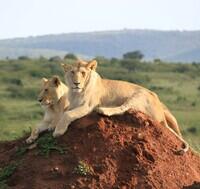
Lions in Kenya
Photo. Kenya is a popular for viewing African lions, especially in Masai Mara National Reserve, Tsavo National Parks, and Amboseli National Park. © Travel Explorations.
Kenya is popular for viewing African lions, with an estimated population inhabiting areas like the Masai Mara National Reserve (900+), Tsavo National Parks (700+), and Amboseli National Park. They face significant threats from human-wildlife conflict and habitat loss, with roughly 2,000 remaining in the country.
Top places to see lions in Kenya
- Masai Mara National Reserve: The premier location with over 850–900 lions, known for the Great Migration and high densities of predators.
- Tsavo National Park (East & West): Known for its large, often maneless, male lions.
- Amboseli National Park: Offers spectacular views of lions with Mt. Kilimanjaro in the background.
- Nairobi National Park: A unique,urban safari destination with a significant lion population just outside the city center.
- Samburu National Reserve: Located in the arid north, home to specialized wildlife and a decent lion population.
Conservation status and threats
Kenya's lion population has decreased alongside a 90% reduction in their historic range across Africa. The top six threats include human-wildlife conflict, habitat loss, disease, infrastructure development, illegal trade, and poor management. There is human-wildlife conflict: As human and livestock populations grow near protected areas, retaliatory killings (using poison or spears) are a major issue, especially after droughts.
According to Animal Survival International, the African lions have lost 90% of their historic range and lion numbers have crashed from as many as 200,000 lions just 100 years ago, to approximately 20,000 in the continent. Lion numbers in Africa have dropped by about 43% over the past 20 years. Today, only around 20,000 lions are believed to remain across the entire continent.
The main reasons are:
- Loss and destruction of natural habitat
- Fewer prey animals to hunt
- Conflict between lions and people
- Local communities lacking support or incentives to protect lions
- Weak or ineffective wildlife management
- Growing illegal trade in lion bones and body parts
The future of Africa’s lions depends on stronger protection, and on people choosing to live alongside them, not against them.
Lions in Kenya are being killed – simply for being lions. There are few safe spaces left for lions in southern Kenya, and those that remain are steadily disappearing. Human settlements are rapidly encroaching on critical lion habitats, and the consequences for wild animals are devastating. 19 August 2024.
Stein Morten Lund, 21st February 2026
Additional information
Animal Survival International, Kenya’s lion population has plummeted 83 percent in the past century, putting the species on the fast-track to extinction. The “king of the jungle” is extinct in 26 African countries. Animal Survival International (ASI) is involved in many projects to protect animals.
WWF-Kenya participated in the development of the African Lion Conservation Strategy.In Kenya, we are working in partnership with KWS and other stakeholders to review the National lion strategy and to conduct a comprehensive nation-wide lion survey using a standardized method called Spatially Explicit Capture Recapture Method.







 E-mail this
 Print this