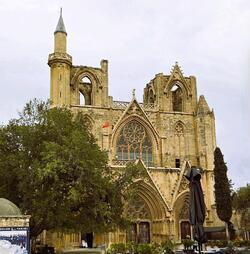
Photo. The Lala Mustafa Pasha Mosque in Famagusta, Northern Cyprus. © Travel Explorations.
In 1974, Turkey invaded Cyprus following a Greek-backed coup. Turkish forces eventually occupied around 37% of the island, including northern Famagusta. As the army advanced, thousands fled their homes.
The famous seaside resort of Varosha in Famagusta was abandoned almost overnight. Hotels, shops and homes were left behind, and the district was fenced off by the Turkish military for decades turning a glamorous Mediterranean resort into an extraordinary time capsule of 1974.
The silence of Varosha stayed with me long after I left. Streets frozen in time. Balconies still facing the sea. A place where life had simply stopped. Then, just a short drive away, everything changed.
From Varosha’s silence to Famagusta’s Soul
I crossed into the Old Town of Famagusta, a quiet reminder that even movement here carries history. The mood softened the moment I stepped onto the massive Venetian Walls of Famagusta. Walking along them felt like moving through centuries. The stone beneath my feet had seen empires rise and fall, yet here it stood grand, calm, enduring.
Passed the grand Famagusta Gate. The archway seemed to invite you in, not just to a town, but to layers of stories. Inside, I wandered slowly through narrow alleyways. No rush. Just letting the place reveal itself. Small shops appeared along the way. I stepped inside a few, exchanging smiles more than words. And then, rising above everything, I found the Lala Mustafa Pasha Mosque. It stopped me.
There are many abandoned churches in and around Famagusta, and they left a strong impression on me. After the events of 1974, large parts of the area were suddenly emptied. Many Greek Orthodox churches were left behind. Some still standing in quiet dignity, others slowly falling into ruin. Walking among them feels different from anything else: doors closed, sometimes broken, icons faded on the walls or where gone, and silence where there was once prayer. Some churches have been preserved, others repurposed, but many remain untouched like time paused.
A town where the past still breathes
And then, rising above everything, I found the Lala Mustafa Pasha Mosque. It stopped me. Here I spend much time just admire the architecture. Built between 1298 and 1400, it became a Catholic cathedral in 1328. After the Ottoman conquest of Famagusta in 1571, it was converted into a mosque and remains one today. Since 1954, it has been named after Lala Mustafa Pasha, who led Ottoman forces in Cyprus.
I could feel the weight of history in its walls. Gothic arches reaching upward, softened by time and transformation. Took a short look inside. This church is active today in contrast to all the hundreds of other churches nearby.
The time it was renamed after the commander of the 1570 Ottoman conquest - infamous for the gruesome torture of Marco Antonio Bragadin, the Venetian commander of the city's fortress. Bragadin had surrendered the city following a brutal 10-month siege in which 6,000 Christian defenders held off an army of more than 100,000 Ottoman Turks.
Stein Morten Lund, April 2026
Additional information
Cyprus is the third-largest island in the Mediterranean, after Sicily and Sardinia. It lies in the eastern Mediterranean, south of Turkey and west of Syria and Lebanon. The country became independent from Britain in 1960. In 1974, Turkey invaded Cyprus following a Greek-backed coup. Turkish forces eventually took control of roughly 36–37% of the island.
Cyprus remains divided today between the internationally recognized Republic of Cyprus in the south and the Turkish-controlled north. A UN buffer zone, known as the Green Line, separates the two sides and even runs through the capital, Nicosia. Nicosia is often described as Europe’s last divided capital.







 E-mail this
 Print this